

Quick answer
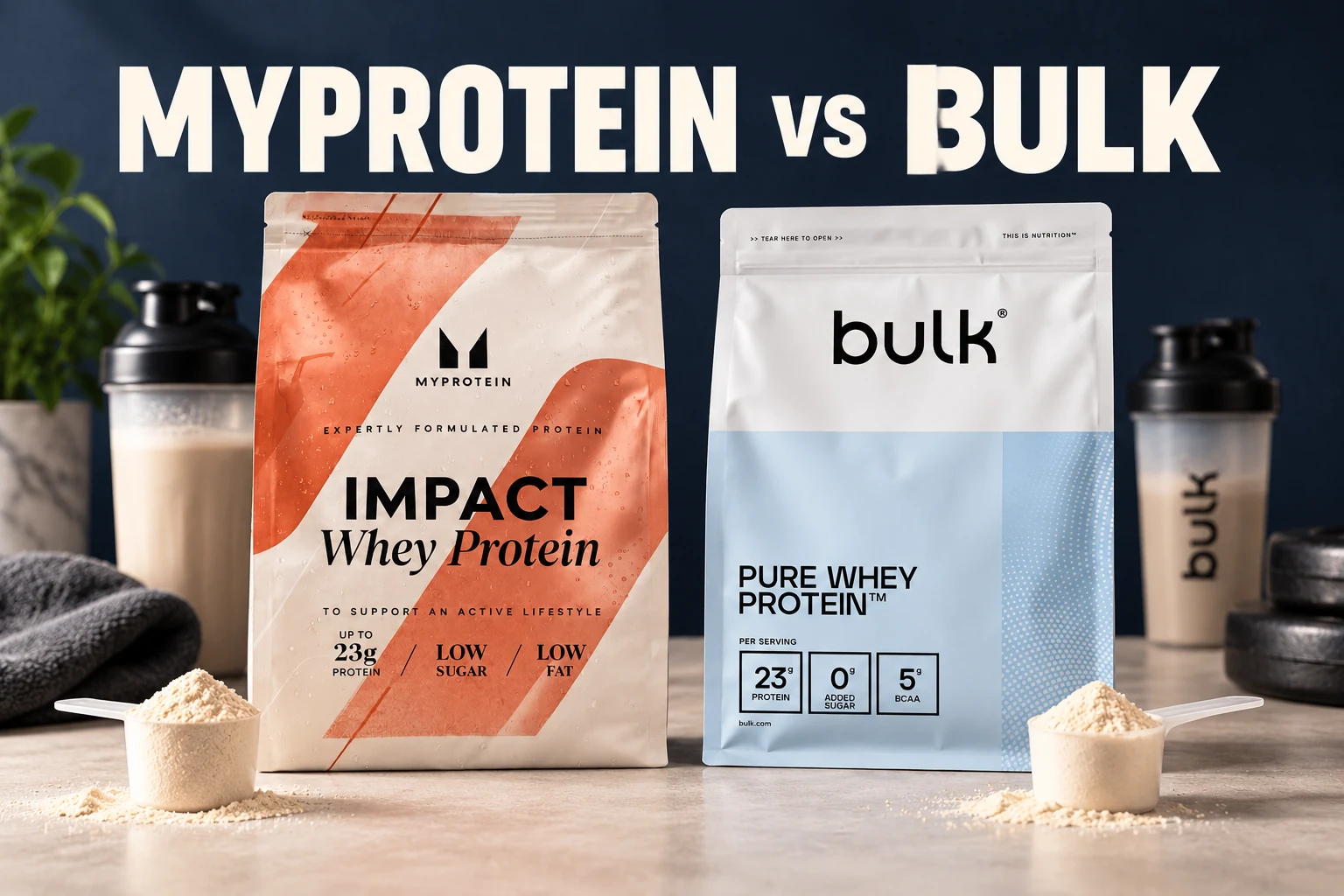
Myprotein is our pick when Impact Whey costs no more than 10% extra per 25g protein because it combines a much larger flavour range with Informed Choice and Informed Protein certification. Bulk wins when Pure Whey is over 10% cheaper or when you want a simpler unflavoured powder. The live table below determines which side of that line today's prices fall.
The decision in 30 seconds
There is no permanent cheapest brand. Myprotein and Bulk change prices by flavour, pack and promotion, so we use a buying threshold rather than declaring whichever brand has the largest sale badge the winner.
Choose Myprotein Impact Whey when its live cost per 25g protein is within 10% of the equivalent Bulk Pure Whey. At that small premium, Myprotein's wider flavour choice and two named testing certifications are useful differences. Choose Bulk Pure Whey when it is more than 10% cheaper, particularly for unflavoured powder going into oats, smoothies or baking.
Open the live Myprotein and Bulk price table for current products, pack sizes and cost per 25g protein. This review explains which products belong in the comparison and what the label changes in an actual shake.
Live comparison
Myprotein and Bulk products
FlavourSize (g)QtyServingsOfferTotal Per 25g protein 43501125.3 £99.99 25.0g132£0.798 1000128.8 £25.99 25.0g127£0.902 50001146 £144.49 25.0g129£0.990 |
FlavourSize (g)QtyServingsOfferTotal Per 25g protein 2250163 £55.99 25.0g156£0.889 750121 £19.99 25.0g156£0.952 375110.8 £11.99 25.0g153£1.110 |
FlavourSize (g)QtyServingsOfferTotal Per 25g protein 50001142 £129.99 25.0g133£0.915 2500171 £67.99 25.0g133£0.958 1000128.4 £27.99 25.0g133£0.986 |
FlavourSize (g)QtyServingsOfferTotal Per 25g protein 50001150 £139.99 25.0g125£0.933 2500175 £74.99 25.0g125£1.000 1000130 £31.99 25.0g125£1.066 |
FlavourSize (g)QtyServingsOfferTotal Per 25g protein 50001112 £107.99 25.0g151£0.964 2500154 £59.99 25.0g162£1.111 1000123.2 £28.49 25.0g155£1.228 |
FlavourSize (g)QtyServingsOfferTotal Per 25g protein 2270173.5 £79.99 25.0g117£1.088 |
FlavourSize (g)QtyServingsOfferTotal Per 25g protein 2270173.5 £79.99£89.99 -11%25.0g117£1.088 |
FlavourSize (g)QtyServingsOfferTotal Per 25g protein 500113.8 £15.99£24.99 -36%25.0g130£1.159 1000127.6 £39.99£44.99 -11%25.0g130£1.449 |
FlavourSize (g)QtyServingsOfferTotal Per 25g protein 1000129.6 £34.49 25.0g128£1.165 |
FlavourSize (g)QtyServingsOfferTotal Per 25g protein 2500177 £91.99 25.0g119£1.195 1000130.8 £39.99 25.0g119£1.298 500115.4 £23.49 25.0g119£1.525 |
FlavourSize (g)QtyServingsOfferTotal Per 25g protein 1000127.6 £37.99 25.0g130£1.376 500113.8 £19.99 25.0g130£1.449 |
FlavourSize (g)QtyServingsOfferTotal Per 25g protein 1020129.4 £44.99 25.0g127£1.532 |
FlavourSize (g)QtyServingsOfferTotal Per 25g protein 600115.8 £27.49 25.0g142£1.735 |
FlavourSize (g)QtyServingsOfferTotal Per 25g protein - £8.99 25.0g495- |




First match the products properly
A brand-wide average can put soy isolate, clear whey, concentrate and premium isolate into one number. That may identify the cheapest catalogue, but it does not tell a whey buyer which equivalent bag is better. We use four separate match-ups instead.
Impact Whey belongs against Pure Whey because both are everyday whey concentrates. Impact Whey Isolate belongs against Pure Whey Isolate. Vegan blends must be checked source by source, while plain creatine monohydrate should be compared by dose and delivered price rather than protein metrics.
| What you want | Myprotein | Bulk | Comparison metric |
|---|---|---|---|
| Everyday whey | Impact Whey | Pure Whey | £ per 25g protein |
| Lower-lactose isolate | Impact Whey Isolate | Pure Whey Isolate | Protein density and £ per 25g protein |
| Plant protein | Exact vegan formula | Exact vegan formula | Sources, protein density and price |
| Plain creatine | Creatine Monohydrate | Creatine Monohydrate | £ per 5g dose |
What the standard whey labels actually say
The current Myprotein Vanilla label lists 72g protein, 379kcal, 8.9g carbohydrate and 5.9g fat per 100g. Its ingredient panel is 96% whey protein concentrate with lecithin, flavouring and sucralose. One 30g serving supplies 22g protein and 114kcal; Myprotein states that nutrition varies by flavour.
That is a complete dairy protein with naturally occurring essential amino acids and BCAAs. The 5g BCAA statement is not evidence of a separately added amino blend: Myprotein describes it as naturally occurring in the whey.
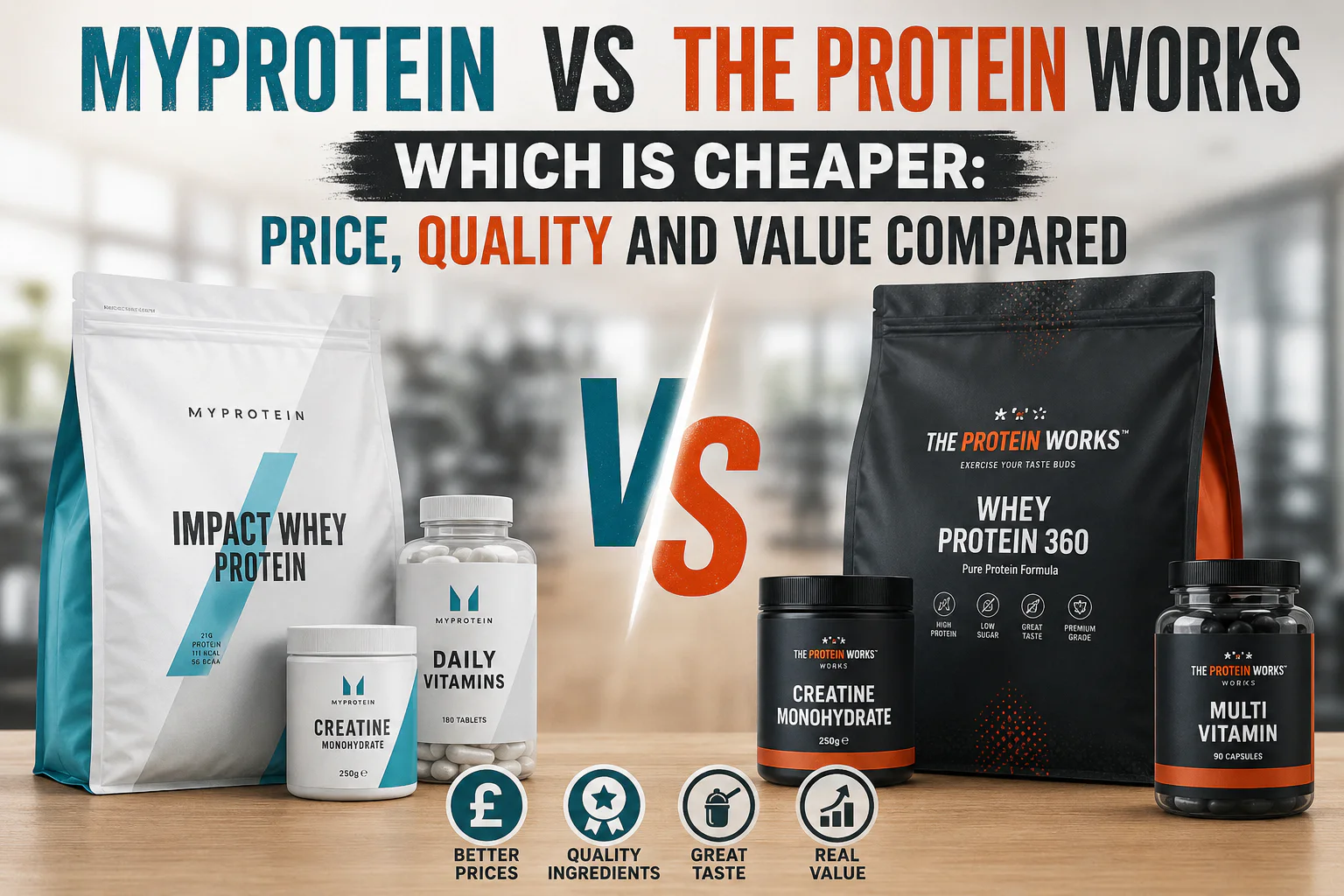
Bulk's displayed Pure Whey panel lists 71g protein per 100g and 23g in a 32g serving. Myprotein Vanilla lists 72g per 100g and 22g in a 30g serving. Those packs are close in protein density, so the checkout cost per 25g protein, not the larger scoop number, is what changes the price verdict. Use the exact flavour shown in the live comparison because cocoa and flavouring can change the label.
Community perspective
What others are saying
Watch what buyers found
Hands-on opinions
I Compared MyProtein's Impact Whey to Every Top Selling Protein in the UK
Tom Newsham Fitness
A broader UK comparison placing Impact Whey alongside mainstream competitors.
Bulk Pure Whey Protein Review
Joe Johnson
A product-specific look at Bulk Pure Whey for practical context beyond its nutrition panel.
Mixability and texture can be predicted only partly
Lecithin is the most relevant label clue for mixing. It helps whey disperse into liquid, so an instantised concentrate containing soya or sunflower lecithin should shake more easily than untreated whey. Myprotein's current Vanilla panel explicitly lists both possible lecithin sources inside the whey concentrate.
Cocoa tends to make chocolate powder feel fuller and can leave more residue than vanilla or unflavoured whey. Biscuit pieces, collagen additions and milkshake-style variants are different formulations again; they should not be used to describe the whole Impact range.
A label cannot prove that one powder tastes better. Water volume, temperature and personal sweetness preference matter. We therefore treat retailer star ratings as supporting evidence, not as a laboratory measurement, and do not award a blanket taste win from one review.
- 1
For water-only shakes: start with a mainstream vanilla or chocolate in the smaller available pack.
- 2
For oats and smoothies: unflavoured whey makes the brand price gap more important than flavour range.
- 3
For less sweetness: check the exact sweetener panel; do not assume every flavour within a brand is identical.
- 4
For fewer lumps: add liquid first, powder second, then shake; formulation cannot rescue poor preparation completely.

Cheapest Myprotein Whey
Impact Whey Protein Powder
MyProtein · 600g
Cons
- 18.3% dearer per 25g protein than the median of 65 other Whey Protein product families in this comparison
Testing is a real Myprotein advantage
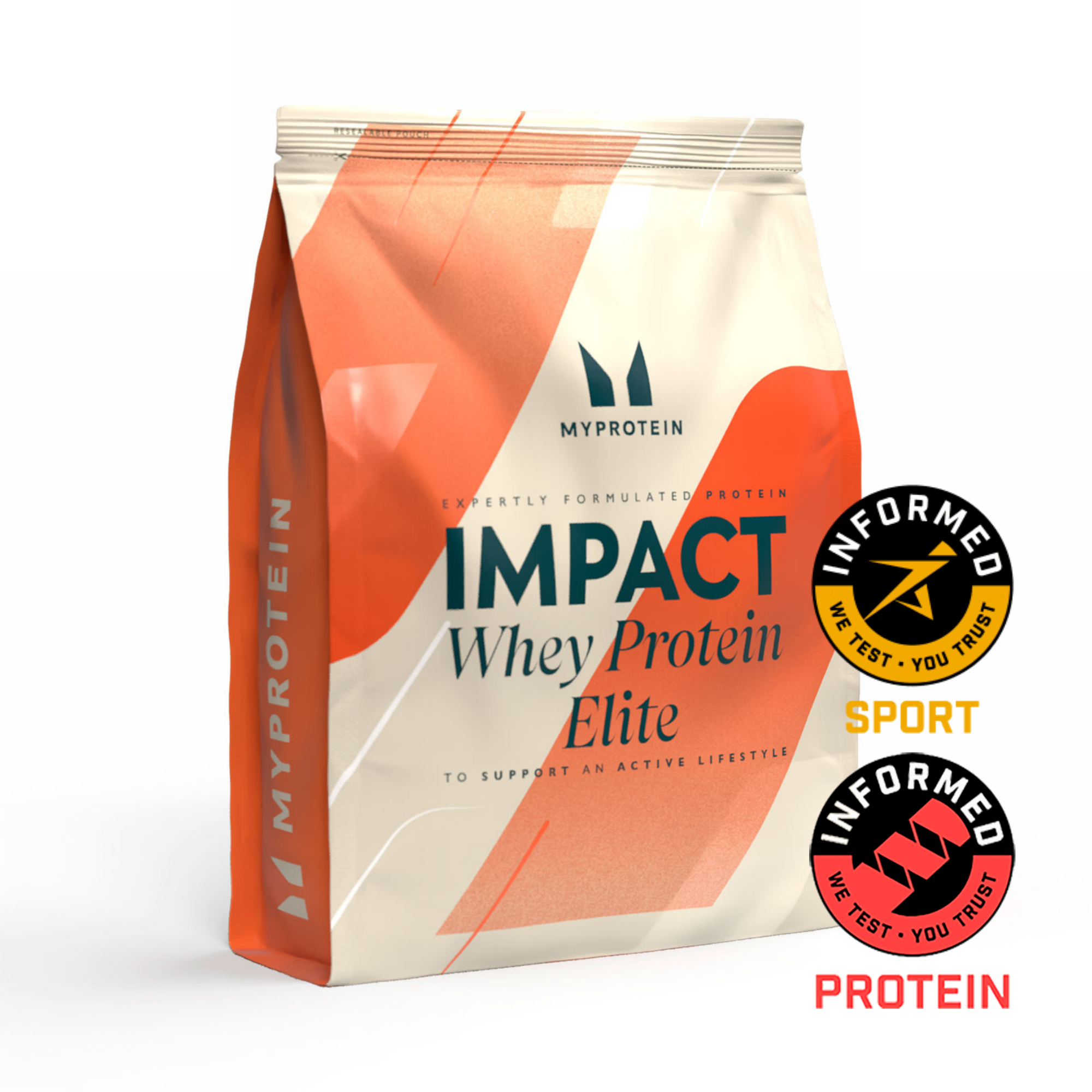
Myprotein currently states that Impact Whey is certified by Informed Choice and Informed Protein. Informed Choice addresses banned-substance risk through an independent testing programme, while Informed Protein verifies that the labelled protein content is accurate.
That distinction matters most to drug-tested athletes and buyers concerned about amino spiking or label accuracy. It does not make Myprotein's whey biologically more complete than another genuine whey concentrate, but it is a reason we allow Myprotein a modest premium when live prices are close.
Bulk may provide quality documentation for individual products or batches, so check the exact product page rather than transferring a certification from one range to every Bulk bag.
The price breakpoint that changes our winner
We calculate the usable protein inside the bag, then divide the final tracked price by those grams. This prevents a low-protein flavour, altered bag size or oversized serving from looking artificially cheap.
For example, if matched Myprotein and Bulk bags cost £1.00 and £0.95 per 25g protein, Myprotein is only 5.3% dearer and remains our pick. If they cost £1.125 and £0.95, Myprotein is 18.4% dearer and Bulk wins. Delivery can move a small order across that line, so confirm the basket total.
Prices in prose become stale quickly. Use the embedded comparison or the live whey table for today's figure, then apply the same 10% rule.
Discount codes, subscriptions and delivery
Myprotein's high reference prices and frequent codes make the percentage discount a poor measure of value. Bulk also runs promotions. In both cases, record the payable price for the exact flavour and size, not the crossed-out price or the largest reduction elsewhere in the promotion.
Treat subscription pricing as a separate purchase mode. It is useful only if the saving remains competitive and the delivery interval matches how quickly you finish the bag. Compare single purchase with single purchase first, then subscription with subscription.
A small bag can lose its apparent advantage once delivery is included. A large bag can reduce cost per 25g protein but should not be called a saving if it forces you to buy more than you need. The live comparison exposes pack total, serving cost and protein cost so you can choose the metric that matches your budget.
- 1
Check the final code-adjusted product price.
- 2
Add unavoidable delivery for the basket you will actually place.
- 3
Keep subscription prices separate from one-off prices.
- 4
Compare the exact size and flavour, because eligibility can differ.
- 5
Ignore the advertised percentage until the final cost per 25g protein is known.
Which brand fits which buyer
Buy Myprotein if you want the largest flavour choice, named third-party certification matters, or its equivalent bag sits within 10% of Bulk on live protein cost. Its current catalogue includes classic, reduced-sweetness, milkshake, collaboration and naturally derived sweetener variants, which gives you more formulation choices but also makes exact-label checking essential.
Buy Bulk when Pure Whey creates a saving greater than 10%, you mainly mix powder into food, or an unflavoured workhorse is the goal. At that point the price difference is large enough to outweigh Myprotein's range and certification advantage for most non-tested buyers.
Buy neither automatically if isolate, vegan protein or digestion is the real requirement. Compare the relevant format across the whole market: a third brand can beat both on lactose, ingredients, amino-acid balance or live price.
| Buyer | Our choice | Reason |
|---|---|---|
| Prices within 10% | Myprotein | More flavour/formulation choice plus named testing |
| Bulk over 10% cheaper | Bulk | The saving outweighs the modest usability premium |
| Drug-tested athlete | Exact certified product | Certification outranks brand-wide assumptions |
| Lactose-sensitive buyer | Compare isolates | Tolerance first, price second |
| Oats, smoothies or baking | Cheapest suitable unflavoured whey | Flavour-range advantage matters less |
Final verdict
Myprotein is our narrow overall winner, not our winner at any price. Impact Whey earns a premium of up to about 10% per 25g protein through its unusually broad flavour range and current Informed Choice and Informed Protein certification.
Bulk is the rational winner when its matched product is more than 10% cheaper. The whey remains a complete protein, and buyers using it in food or choosing unflavoured powder gain less from Myprotein's larger flavour catalogue.
Open the live Myprotein and Bulk price table before ordering. If both look poor, use the protein comparison and select price per 25g protein, or check current protein powder deals rather than forcing a two-brand decision.
References
Sources and further reading
- 01Myprotein — Impact Whey Protein Powder
Official current nutrition, ingredients, serving guidance, flavour range, rating and certification claims.
- 02Bulk — Pure Whey Protein
Official product information used for the matched Bulk whey comparison.
- 03Informed Sport — Informed Choice
Information about the third-party banned-substance testing programme cited by Myprotein.
- 04Informed Sport — Informed Protein
Information about independent verification of protein label claims.
- 05Competition and Markets Authority — price-reduction claims
UK guidance on reference prices, reductions and urgency claims.
Frequently asked questions
Is Myprotein or Bulk cheaper?+
It changes by product, flavour, size and promotion. Compare equivalent products using the final cost per 25g protein; Bulk is our choice when it is more than roughly 10% cheaper.
Is Bulk better than Myprotein?+
Bulk is better when its matched product creates a clear saving or you want a straightforward unflavoured powder. Myprotein is our choice when prices are close because of its flavour range and named testing certifications.
Which has better protein quality?+
Both standard whey products use complete dairy protein. Myprotein currently adds a verification advantage through Informed Choice and Informed Protein certification, but compare certifications on the exact product rather than assuming they cover every range.
Which mixes better, Myprotein or Bulk?+
Mixability depends on the exact flavour and formula. Lecithin helps powder disperse, while cocoa and inclusions can make a shake thicker or leave more residue. A brand-wide winner cannot be established from one flavour.
Should I compare price per serving or per kilogram?+
Use cost per 25g protein for value, then check serving price for budgeting. Price per kilogram ignores differences in protein density, while retailer serving sizes are not always equivalent.