

Quick answer
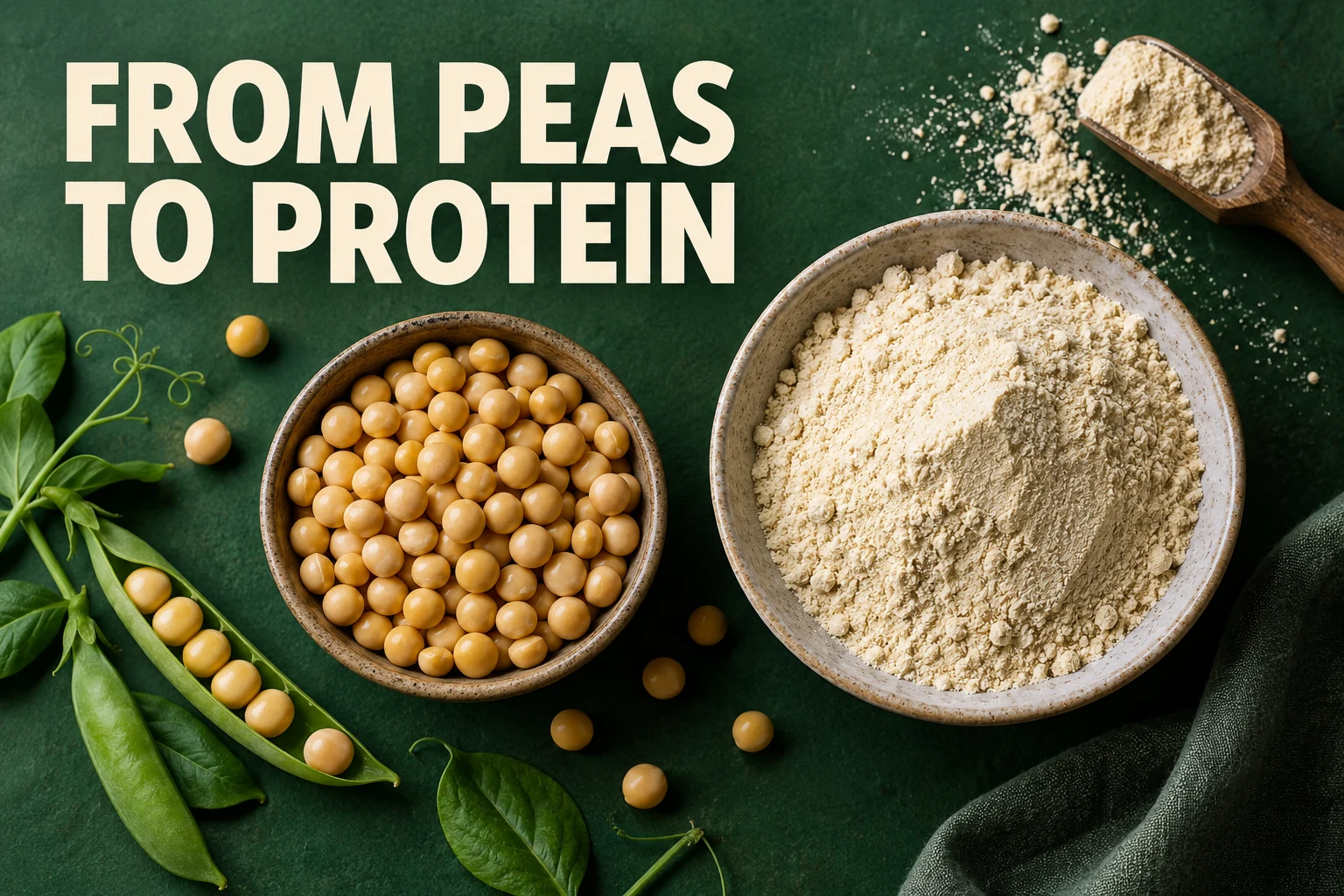
Pea protein powder normally starts with cleaned yellow field peas. Manufacturers remove the hulls, mill the peas into flour and separate protein from starch and fibre. Dry fractionation uses air classification to make a less-refined concentrate; wet fractionation uses water and controlled pH changes to make a higher-protein isolate. The protein-rich material is then dried into the powder sold on its own or used in vegan blends.
The short version
Pea protein is usually made from yellow field peas, not green garden peas. Dry fractionation produces a less-refined concentrate; wet separation and drying produce a higher-protein isolate. Neither route automatically makes a finished powder good—the label, amino-acid balance, taste and price still decide that.
Our buying preference is a pea-and-rice blend rather than pea alone, because the sources complement one another. Form Performance Protein is our premium blend and Bulk Vegan Protein is our value option; plain pea isolate is best when price or recipe flexibility matters more than texture.
From whole pea to powder in seven stages
A factory line is more complicated than a kitchen recipe, but the useful buying-level version can be reduced to seven stages. The route divides after milling: a dry process heads towards air classification, while a wet process heads towards extraction and separation.
- 1
Clean and grade the peas. Screens, magnets and optical sorting remove soil, stones, damaged seeds and foreign material.
- 2
Dehull the seed. Removing the fibrous outer coat improves the composition of the flour entering the separation line.
- 3
Mill the peas. The dehulled peas are ground so protein-rich particles can be separated from larger starch granules.
- 4
Choose dry or wet fractionation. Air classification produces concentrate; water-based extraction can produce a more purified isolate.
- 5
Recover the protein-rich fraction. Cyclones collect fine particles in a dry line, while centrifuges or filtration separate streams in a wet line.
- 6
Dry when required. Wet protein slurry is commonly spray-dried into a shelf-stable powder; dry-fractionated material already avoids this water-removal stage.
- 7
Blend and pack. An ingredient may be sold unflavoured or combined with rice protein, flavouring, sweetener, thickeners and micronutrients.
Cleaning, dehulling and milling do more than make flour
The first steps determine how efficiently the later separation works. Pea hulls are rich in fibre but dilute the protein fraction, so manufacturers usually crack the seeds and remove the hull before fine milling. The remaining cotyledon is mostly starch and protein, with those components behaving differently when ground.
Particle size is the useful trick. Pea starch remains in comparatively large, dense granules, while disrupted protein bodies form finer particles. Careful milling frees those components without reducing everything to an indistinguishable dust. Research on field-pea processing shows that the milling protocol can change subsequent starch yield and purity, which is why two factories starting with similar peas can obtain different ingredient properties. See the field-pea milling study for the underlying processing work.
Nothing at this stage resembles a finished vanilla shake. It is still pea flour: pale, earthy and rich in starch. The meaningful concentration happens next.
Dry fractionation makes a concentrate
In a dry line, finely milled pea flour enters an air classifier. Fast-moving air and centrifugal forces sort particles by size and density. The lighter protein-rich fines travel into one collection stream, while the heavier starch-rich particles enter another. Repeating the pass can raise protein concentration further, although every extra separation involves a trade-off between purity and how much protein is recovered.
The attraction is simplicity: there is no large water stream to remove and no acid or alkali extraction stage. Protein remains closer to its native state, which can preserve useful functional behaviour in foods. The limitation is purity. Recent fractionation research describes dry concentrates as generally lower in protein than wet isolates because some starch and fibre remain with the fine fraction. The dry-fractionation study explains the milling and air-classification route in detail.
For a buyer, a concentrate is not failed isolate. It is a deliberately less-purified ingredient. It may be perfectly sensible in baking or blended foods, but its lower protein density means it must be cheaper enough to compensate when judged per 25g protein.
| Question | Dry fractionation | Wet fractionation |
|---|---|---|
| Main separation tool | Milling and air classification | Water, pH control, centrifugation or filtration |
| Typical product | Pea protein concentrate | Pea protein isolate |
| Protein purity | Lower because more starch and fibre remain | Higher because more non-protein material is removed |
| Drying demand | No slurry needs spray drying | Extracted protein must be dried |
| Buying implication | Judge the lower protein percentage against the cheaper price | Do not assume higher purity automatically means better value |

Cheapest Vegan Protein
Soy Protein Isolate Powder – 90% Protein
Pure Source Nutrition · 500g
Pros
- Provides 25g protein for about 103 kcal, keeping non-protein calories low (0.4g fat)
Wet fractionation makes a higher-protein isolate
Wet fractionation begins by mixing pea flour with water. In a common alkaline extraction and isoelectric precipitation route, the manufacturer raises the pH so more protein moves into solution. Insoluble fibre and starch can then be separated from the liquid using centrifugation or filtration.
The protein-containing liquid is subsequently moved towards the protein's isoelectric region, where solubility drops and protein can be recovered as a curd-like precipitate. Washing removes more residual non-protein material. The recovered protein is then neutralised and redispersed before drying. Some factories instead use membrane filtration, salt extraction or milder processes, so "pea isolate" describes the composition of the result rather than one universal recipe.
These conditions influence more than the number on the nutrition panel. pH shifts, heat and drying can change protein structure, solubility, emulsification and gel formation. A recent review of pea protein extraction and functionality describes the central trade-off: processes that increase purity can also alter the functional properties manufacturers need to manage in the finished drink.
Spray drying turns liquid protein into the familiar powder
A wet-extracted protein slurry cannot go directly into a resealable pouch. It contains too much water for convenient transport or long storage. During spray drying, the slurry is atomised into tiny droplets inside a stream of hot air. Their large surface area lets water evaporate quickly, leaving dry particles that are collected from the chamber.
The air may be hot, but the droplet does not simply sit at that temperature like food in an oven. Evaporation cools it while moisture is being removed. Even so, inlet temperature, outlet temperature, solids content and droplet size all influence the final particle. Poor control can contribute to aggregation, reduced solubility or powder that wets slowly and forms stubborn floating clumps.
After drying, manufacturers may sieve or agglomerate the powder. Agglomeration joins very fine particles into larger porous granules, helping water penetrate when the powder reaches a shaker. That is one reason two products listing pea protein isolate first can behave differently even before flavour systems and gums are considered.
Concentrate and isolate are not interchangeable labels
The clearest difference is concentration. An isolate has undergone more extensive separation and normally provides more protein with less starch and fibre. A concentrate retains more of the original pea fraction. Exact percentages vary, so the nutrition panel is more useful than relying on the front-of-pack term.
Higher protein density can make isolate easier to fit into a calorie target and may reduce the amount of powder needed for a given protein dose. Concentrate can still win on value if its price falls far enough. Work out cost per 25g protein, not merely price per kilogram of powder; the protein cost guide shows the calculation step by step.
| Check | Pea concentrate | Pea isolate |
|---|---|---|
| Processing | Usually dry-fractionated | Usually wet-extracted |
| Protein per 100g | Typically lower | Typically higher |
| Starch and fibre | More retained | More extensively removed |
| Best comparison metric | Final cost per 25g protein | Final cost per 25g protein |
| Automatic winner? | No | No |
Why pea protein can taste earthy or feel sandy
Pea flavour is not created by one single compound. The raw crop, storage, oxidation, extraction conditions and residual non-protein material all affect the aroma reaching the finished powder. Manufacturers can reduce unwanted notes through crop selection, processing and flavour masking, but an unflavoured isolate is unlikely to become genuinely flavourless.
Texture has several possible causes too. Fine insoluble material can feel chalky, aggregated protein may disperse poorly, and a thick shake can amplify particles that would be less obvious in a thinner drink. Blending pea with rice protein changes the amino-acid profile and texture, while lecithin, gums and agglomeration change how quickly the powder wets and remains suspended.
Buyer comments cannot identify which factory step caused a particular texture, but they reveal how large the real-world difference can be. Trial a small pack before committing to several kilograms, especially if you plan to mix it only with water.
What others are saying
Feels like I mixed sand into my drink.
u/Dench-777 in r/veganfitness, January 2025
Rice protein to me tastes far better than pea. It's a bit less grittier with a milder taste.
u/aggropopspuffs in r/veganfitness, January 2025
It mixes really well, has a smooth taste and texture while drinking.
u/Crasino_Hunk in r/veganfitness, May 2026
What processing changes nutritionally
Fractionation mainly changes proportions. Removing starch and fibre raises protein as a share of the powder, while washing can reduce some soluble compounds. Pea protein remains relatively rich in lysine and comparatively limited in sulphur-containing amino acids such as methionine, which is why pea and rice are frequently paired in vegan blends.
Processing can also reduce some antinutritional compounds, but the result depends on the route and settings; "isolate" is not a guarantee that every such compound has disappeared. Reviews of pea ingredients describe dry, wet, salt-based and newer assisted extraction methods, each with different purity and functionality outcomes. See the food-industry review for a broader map of those methods.
For ordinary buying, the useful checks remain straightforward: protein per 100g, ingredient list, serving size, amino-acid information where supplied, and whether the powder is tolerable enough to use consistently. Manufacturing language should help explain those numbers, not replace them.
How to read a pea protein label
A label cannot tell you every extraction parameter, but it can answer the questions that matter most at checkout. Use this order rather than being distracted by claims such as "clean", "natural" or "premium".
- 1
Find pea protein isolate or pea protein concentrate in the ingredient list and note whether pea is the only protein or part of a blend.
- 2
Check protein per 100g. This reveals how much of the powder is protein more clearly than an adjustable scoop size.
- 3
Compare cost per 25g protein using the actual sale price, not RRP or the discount percentage.
- 4
Look for rice, soy or another complementary protein if amino-acid balance matters more to you than buying a single-source powder.
- 5
Check sweeteners, gums and flavourings separately. They often explain taste and texture differences that the word "isolate" cannot.
- 6
Buy a trial size first if texture is a concern, then use the vegan protein comparison to price the larger pack.
The buying conclusion
Choose isolate when its higher protein density, lower residual starch or easier portioning solves a real problem for you. Choose concentrate when the nutrition panel is still strong and its lower price produces a better cost per 25g protein. For many buyers, a pea-and-rice blend will be the more rounded everyday shake, particularly if it improves taste enough that the bag actually gets finished.
The process explains why products differ, but it does not decide the winner. Current price, protein percentage and whether you can tolerate the texture do that. Open the live vegan comparison, choose the metric based on protein rather than bag weight, and compare the exact flavour and pack you intend to buy.
Watch what buyers found
Hands-on opinions
What's Up with PEA PROTEIN? Pros and Cons...
SuperfoodEvolution
A topic-specific video selected for additional practical context on How Is Pea Protein Powder Made? From Yellow Peas to Protein Isolate.
References
Sources and further reading
- 01ProteinDeals — live product comparison
Current product, nutrition and retailer data used for the article's buying context.
Frequently asked questions
What is pea protein powder made from?+
It is normally made from dried yellow field peas. The peas are cleaned, dehulled and milled before protein is separated from much of the starch and fibre.
How is pea protein isolate made?+
A common method disperses pea flour in water, adjusts pH to extract protein, separates starch and fibre, precipitates and washes the protein, then neutralises and spray-dries it. Membrane and other extraction methods also exist.
Is pea protein isolate highly processed?+
It is more extensively fractionated than whole pea flour or a dry concentrate. That processing raises protein purity, but 'processed' alone does not establish whether a food is nutritionally suitable or good value.
Why does pea protein feel gritty?+
Poor dispersion, protein aggregation, very fine insoluble particles and a thick mixture can all contribute. Processing, agglomeration and added emulsifiers differ between products, so texture can vary considerably between brands.
Is pea protein concentrate or isolate better?+
Neither wins automatically. Isolate normally contains a higher percentage of protein, while concentrate may cost less. Compare the nutrition panel and final cost per 25g protein, then account for taste and texture.