Muscle Gain Calculator
Set your monthly muscle gain target and get the exact calorie surplus and protein needed to hit it.
Science
How This Calculator Works
Working Backwards From Your Target
Most calculators give you a surplus and tell you to hope for the best. This one works backwards: you set how much muscle you want to gain per month, and the calculator derives the exact daily calorie surplus required. The formula is: surplus per day = (target kg × 7,000 kcal) ÷ 30 days. Protein is then set against your lean body mass — not total bodyweight — which is more accurate because fat tissue has no protein requirement.
The 7,000 kcal Figure
One kilogram of skeletal muscle is approximately 70% water, 22% protein and 8% other compounds including glycogen and minerals. Building that kilogram requires synthesising roughly 220g of new muscle protein. At 4 kcal/g, that is ~880 kcal in protein alone — but the total energy cost of muscle protein synthesis, including the metabolic overhead of building and maintaining new tissue, brings the real-world figure closer to 7,000–8,000 kcal per kg. Hall et al. (2012) and Forbes (1987) both support this range. This calculator uses 7,000 kcal/kg as the conservative lower estimate.
Related reading
Realistic Gain Rates by Training Age
Muscle gain is governed by your training age — how long you have been resistance training consistently. The closer you are to your genetic ceiling, the slower the rate. Lyle McDonald's model and subsequent research set these approximate monthly ceilings:
Beginner
< 1 year lifting
Up to 1 kg/month
Intermediate
1–3 years lifting
Up to 0.75 kg/month
Advanced
3+ years lifting
Up to 0.35 kg/month
These figures assume consistent progressive overload, adequate sleep (7–9 hours), and no performance-enhancing drugs. Female lifters should expect approximately 50–60% of these rates due to lower testosterone levels.
Lean Body Mass and Protein
Protein is set at 2.2g per kg of lean body mass (LBM). LBM is calculated as: total weight × (1 − body fat% / 100). Using LBM rather than total bodyweight avoids overestimating protein needs for individuals carrying significant fat mass. The 2.2g/kg LBM target is supported by Morton et al. (2018) and aligns with the upper range of the ISSN Position Stand (2022) for individuals in a calorie surplus with active resistance training.

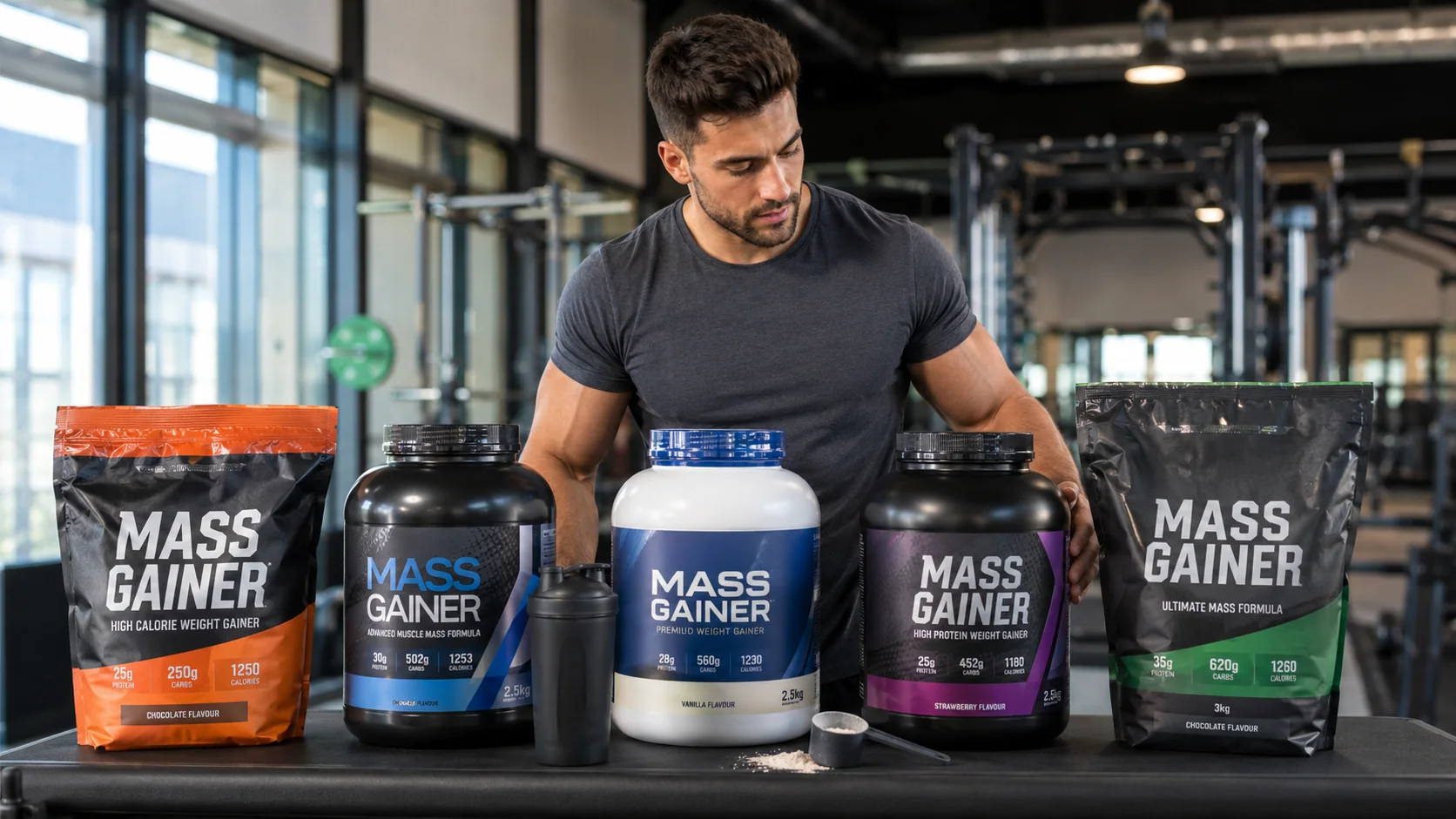
Cheapest Mass Gainer
Hard Gainer Powder
Pure Source Nutrition · 5kg
Pros
- 48% below the £1.08/100g average across 10 comparable /compare listings
- 24g protein per 100g
Why Not a Bigger Surplus?
A larger surplus does not build muscle faster — it primarily increases fat storage. Barakat et al. (2020) reviewed lean bulking protocols and found that surpluses beyond the rate at which muscle can actually be synthesised are stored as fat. The surplus generated by this calculator is calibrated to your target gain rate, meaning you eat exactly enough to support the muscle growth you are aiming for — no more, no less.
Important Note
These are evidence-based estimates. Individual metabolism varies by 10–15% from formula predictions, and actual muscle gain depends heavily on training quality, sleep, stress and genetic factors. If you are not gaining at the expected rate after 3–4 weeks, increase calories by 100–150 kcal and reassess. This calculator is for educational purposes and does not replace advice from a registered dietitian or sports nutritionist.