
Quick answer
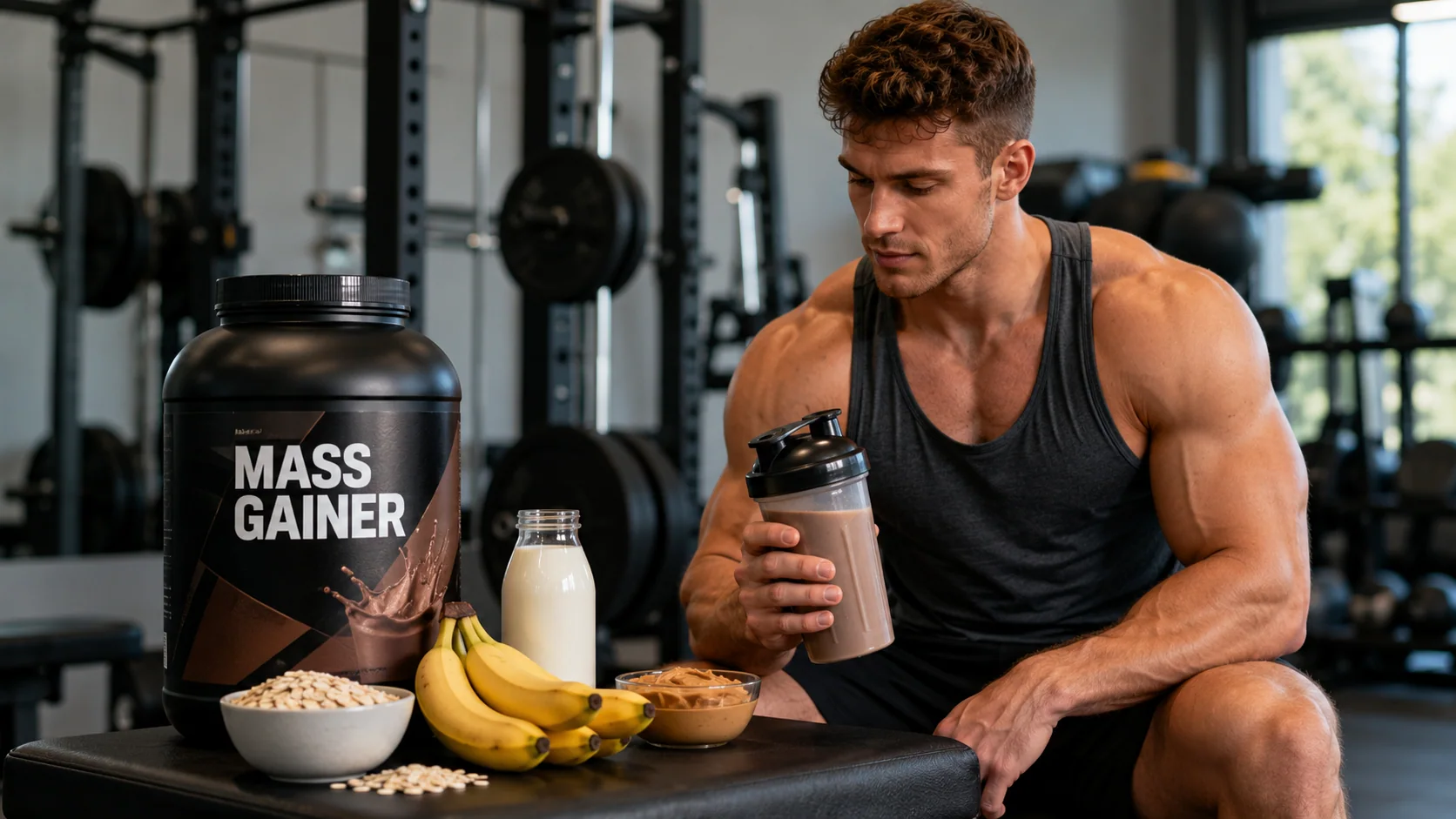
A mass gainer is protein plus a large amount of carbohydrate and calories. It is useful only when eating enough is the actual barrier to gaining weight. We prefer a homemade whey, oats, milk and banana shake; Applied Nutrition Critical Mass is our ready-made pick and Warrior is our budget option.
What a mass gainer actually contains
A mass gainer is a high-calorie protein powder designed to make hitting a caloric surplus easier. The defining feature is a large carbohydrate content alongside the protein, typically a ratio of 2:1 to 5:1 carbohydrates to protein, depending on the product.
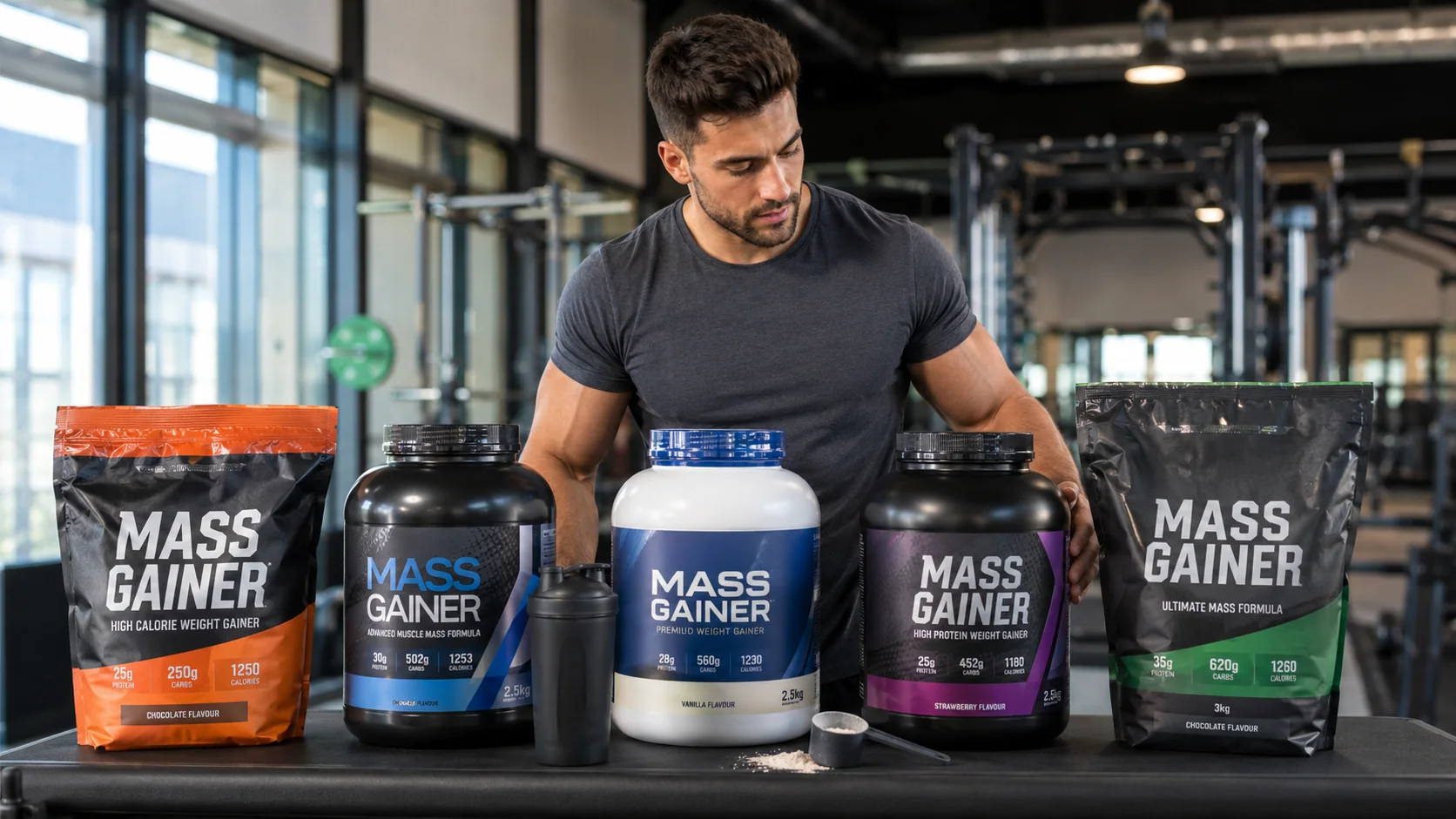
A single serving often delivers 500-1,200 calories, 40-60g of protein, and 80-250g of carbohydrates. The carbohydrate sources vary by product: oats, maltodextrin, waxy maize starch, and dextrose are common. Some products include added fats from oils or nut butters to push calorie counts higher still.
Live comparison
Mass Gainer products
FlavourSize (g)QtyServingsOfferTotal Per serving 5000124 £27.99 50.4g1029£1.166 3000114 £24.99 50.4g1029£1.785 2000110 £16.99 50.4g1029£1.699 |
FlavourSize (g)QtyServingsOfferTotal Per serving 4000132 £25.99 30.0g479£0.812 |
FlavourSize (g)QtyServingsOfferTotal Per serving 2000116 £14.99£32.00 -53%30.0g471£0.937 |
FlavourSize (g)QtyServingsOfferTotal Per serving 5000137 £39.99 28.0g460£1.081 |
FlavourSize (g)QtyServingsOfferTotal Per serving 5000118 £39.99 53.0g1059£2.222 |
FlavourSize (g)QtyServingsOfferTotal Per serving 8480132 £82.49 51.0g1006£2.578 4240116 £46.99 51.0g1006£2.937 212018 £26.49 51.0g1006£3.311 |
FlavourSize (g)QtyServingsOfferTotal Per serving 2740110 £30.00 50.0g1000£3.000 |
FlavourSize (g)QtyServingsOfferTotal Per serving 5000132 £54.99 43.0g572£1.718 2500116 £29.99 43.0g572£1.874 100016 £12.99 43.0g572£2.165 |
FlavourSize (g)QtyServingsOfferTotal Per serving 200017 £23.00 20.0g376£3.286 |
FlavourSize (g)QtyServingsOfferTotal Per serving 2500125 £29.99 31.0g369£1.200 |
FlavourSize (g)QtyServingsOfferTotal Per serving 4800124 £59.99 --£2.500 |
FlavourSize (g)QtyServingsOfferTotal Per serving 8000140 £107.49 50.0g769£2.687 4000120 £59.99 50.0g769£3.000 2000110 £34.99 50.0g769£3.499 |
FlavourSize (g)QtyServingsOfferTotal Per serving 2721.5518 £37.00 46.0g1225£4.625 997.913 £18.00 46.0g1225£6.000 |
FlavourSize (g)QtyServingsOfferTotal Per serving 5000150 £67.99 31.0g391£1.360 2500125 £35.49 29.0g383£1.420 1000110 £14.99 29.0g383£1.499 |
FlavourSize (g)QtyServingsOfferTotal Per serving 5000159 £68.99 37.0g314£1.169 2500129 £37.99 37.0g314£1.310 1000112 £16.99 37.0g314£1.416 |
FlavourSize (g)QtyServingsOfferTotal Per serving 2500120 £34.99 33.0g451£1.750 |
FlavourSize (g)QtyServingsOfferTotal Per serving 5400118 £78.99 60.0g1121£4.388 200017 £36.99 60.0g1121£5.284 |
FlavourSize (g)QtyServingsOfferTotal Per serving 5450116 £82.00 50.0g1260£5.125 273018 £50.00 50.0g1260£6.250 |
FlavourSize (g)QtyServingsOfferTotal Per serving 3200130 £49.95 25.4g400£1.665 |
FlavourSize (g)QtyServingsOfferTotal Per serving 2267.9618 £38.00 56.0g1100£4.750 |
FlavourSize (g)QtyServingsOfferTotal Per serving 3150130 £69.95 30.0g400£2.332 |


Who mass gainers are genuinely useful for
Mass gainers solve one specific problem: getting enough calories when eating whole food alone is difficult. This matters most for people with fast metabolisms, small appetites, or physically demanding lifestyles where food intake struggles to keep pace with energy expenditure.
Hard gainers, people who find it genuinely hard to eat enough, are the target user. If you are trying to add bodyweight and repeatedly fail to hit your caloric target through food, a mass gainer shake is a practical way to add 600-800 calories with minimal effort.
Who does not need a mass gainer
If you can hit your caloric target through food without struggling, you do not need a mass gainer. The calories in a mass gainer are not different from calories in food. They do not trigger faster muscle growth by themselves.
People prone to fat gain who are already eating adequate calories should be especially cautious. A mass gainer consumed on top of a sufficient diet simply adds excess calories, which will be stored as fat regardless of the protein content.
Community perspective
What others are saying
I'd rather just have a muffin than a mass gainer. Cheaper, tastier, and just more fun.
u/LordHydranticus in r/workout
Is mass gainer more expensive than whey protein? Because where I live it's significantly cheaper. It's like half the price per unit of mass. Of course it comes with a shit ton of simple carbs and between 20-40 g of protein/100 g
u/Middle-Gas-6532 in r/workout
Real food is cheaper, more nutrient dense and more bioavailable than mass gainers. Protein powder is a supplement. Save shakes for those times that you’re struggling to meet your protein macro or would otherwise miss a meal. Eat your protein, don’t drink it.
u/friedrichbythesea in r/workout
Watch what buyers found
Hands-on opinions
Should Skinny Guys Take Whey Protein or Mass Gainer?
Josef Rakich
A topic-specific video selected for additional practical context on What is a Mass Gainer: Best Options Compared for 2026.
Mass gainer vs making your own
The same caloric effect can be produced more cheaply and with better ingredient control by blending whey protein with oats, milk, banana and nut butter. A homemade shake can hit 700-900 calories with whole-food carbohydrate sources, higher fibre, and lower cost per calorie than most commercial mass gainers.
Commercial mass gainers are convenient. They are pre-measured, shelf-stable and fast to mix. But convenience is the main argument for them, not superior nutrition or better gains.

Cheapest Mass Gainer
Hard Gainer Powder
Pure Source Nutrition · 2kg
Pros
- 30.3% below the £1.22/100g average across 21 comparable /compare listings
- 24g protein per 100g
What to look for when buying
Prioritise protein content per serving over the total calorie count. A mass gainer with 50g protein per serving is more useful than one with 30g protein padded with cheap carbohydrates to inflate the calorie number.
Check the carbohydrate source. Products using oats or complex carbohydrates are preferable to those relying primarily on maltodextrin or simple sugars, which digest quickly and offer less satiety per calorie.
Compare on cost per serving and cost per gram of protein, not just the headline bag price. Large bags can look cheap until you divide by the number of servings they actually contain.
References
Sources and further reading
- 01Competition and Markets Authority — price-reduction claims
UK guidance relevant to reference prices, discount claims and online urgency messaging.
Frequently asked questions
Will a mass gainer make me fat?+
If consumed in excess of your total calorie needs, yes. Mass gainers are calorie-dense tools. They work for weight gain when you are genuinely in a deficit or struggling to hit a surplus, but they add fat like any excess calorie source if overused.
Can I take a mass gainer without working out?+
You will gain weight, but most of it will be fat rather than muscle. Mass gainers need to be paired with resistance training to produce meaningful muscle growth from the additional calories.
Is a mass gainer better than whey protein for bulking?+
It depends on whether you are struggling to eat enough calories. If you can hit your caloric target through food and regular whey, a mass gainer adds nothing extra. If you genuinely cannot eat enough, the extra calories in a mass gainer are useful.