
Quick answer
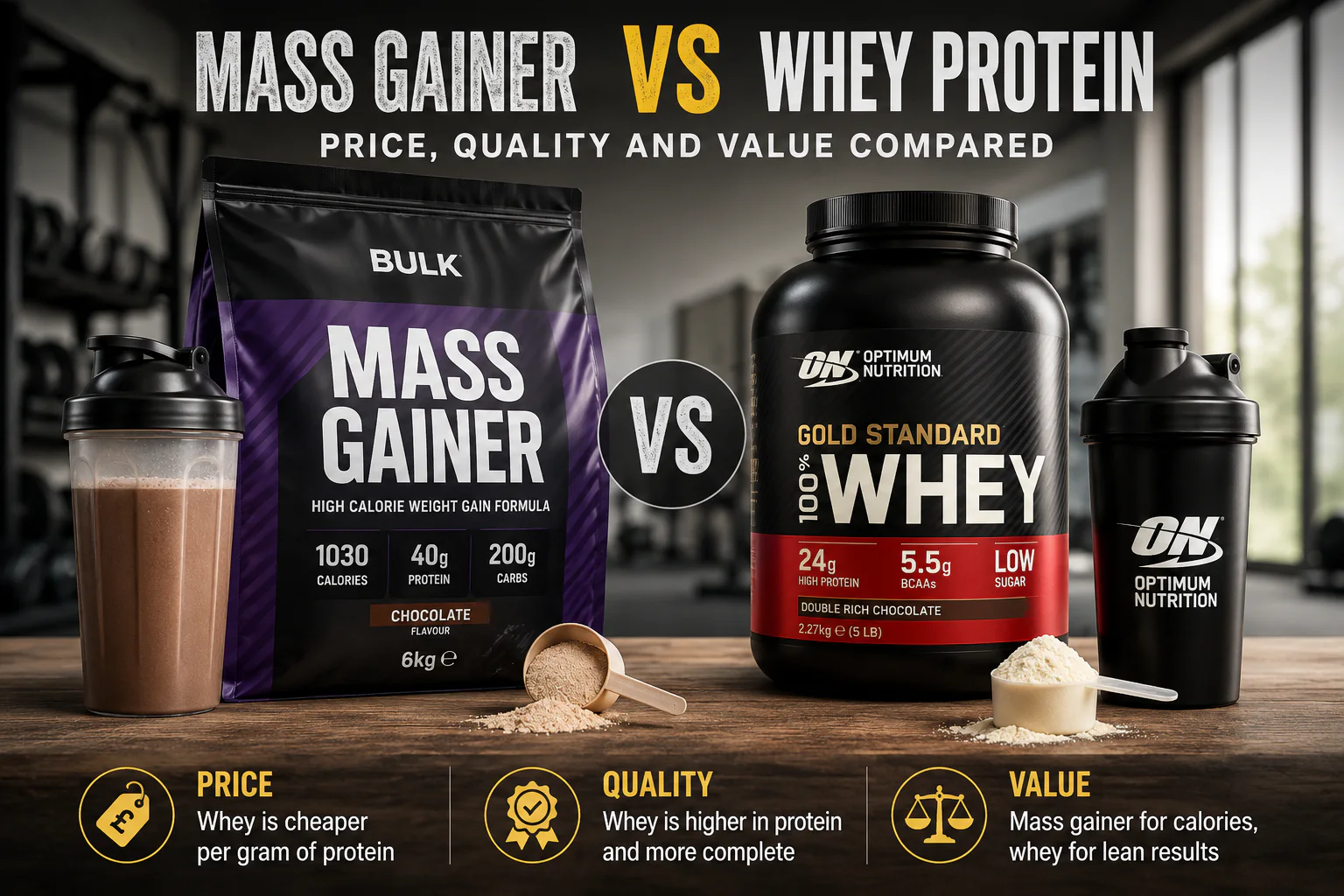
Whey protein wins for most people because it fills a protein gap without forcing hundreds of extra calories. Mass gainer wins only when a consistent calorie surplus is difficult to eat. Start with whey and food; add a commercial gainer after appetite and convenience—not marketing—prove to be the bottleneck.
The core difference
Whey protein is a concentrated protein source. A typical serving delivers 25g of protein and around 110-130 calories, with minimal carbohydrates and fat. Its purpose is to help you hit your daily protein target conveniently.
A mass gainer is a high-calorie powder built around a combination of protein and carbohydrates. A single serving often delivers 500-1,000 calories with 40-60g of protein and 100-200g of carbohydrates. Its purpose is to help you hit a caloric surplus, not just a protein target.
Live comparison
Mass Gainer products
FlavourSize (g)QtyServingsOfferTotal Per serving 5000124 £27.99 50.4g1029£1.166 3000114 £24.99 50.4g1029£1.785 2000110 £16.99 50.4g1029£1.699 |
FlavourSize (g)QtyServingsOfferTotal Per serving 4000132 £25.99 30.0g479£0.812 |
FlavourSize (g)QtyServingsOfferTotal Per serving 2000116 £14.99£32.00 -53%30.0g471£0.937 |
FlavourSize (g)QtyServingsOfferTotal Per serving 5000137 £39.99 28.0g460£1.081 |
FlavourSize (g)QtyServingsOfferTotal Per serving 5000118 £39.99 53.0g1059£2.222 |
FlavourSize (g)QtyServingsOfferTotal Per serving 8480132 £82.49 51.0g1006£2.578 4240116 £46.99 51.0g1006£2.937 212018 £26.49 51.0g1006£3.311 |
FlavourSize (g)QtyServingsOfferTotal Per serving 2740110 £30.00 50.0g1000£3.000 |
FlavourSize (g)QtyServingsOfferTotal Per serving 5000132 £54.99 43.0g572£1.718 2500116 £29.99 43.0g572£1.874 100016 £12.99 43.0g572£2.165 |
FlavourSize (g)QtyServingsOfferTotal Per serving 200017 £23.00 20.0g376£3.286 |
FlavourSize (g)QtyServingsOfferTotal Per serving 2500125 £29.99 31.0g369£1.200 |
FlavourSize (g)QtyServingsOfferTotal Per serving 4800124 £59.99 --£2.500 |
FlavourSize (g)QtyServingsOfferTotal Per serving 8000140 £107.49 50.0g769£2.687 4000120 £59.99 50.0g769£3.000 2000110 £34.99 50.0g769£3.499 |
FlavourSize (g)QtyServingsOfferTotal Per serving 2721.5518 £37.00 46.0g1225£4.625 997.913 £18.00 46.0g1225£6.000 |
FlavourSize (g)QtyServingsOfferTotal Per serving 5000150 £67.99 31.0g391£1.360 2500125 £35.49 29.0g383£1.420 1000110 £14.99 29.0g383£1.499 |
FlavourSize (g)QtyServingsOfferTotal Per serving 5000159 £68.99 37.0g314£1.169 2500129 £37.99 37.0g314£1.310 1000112 £16.99 37.0g314£1.416 |
FlavourSize (g)QtyServingsOfferTotal Per serving 2500120 £34.99 33.0g451£1.750 |
FlavourSize (g)QtyServingsOfferTotal Per serving 5400118 £78.99 60.0g1121£4.388 200017 £36.99 60.0g1121£5.284 |
FlavourSize (g)QtyServingsOfferTotal Per serving 5450116 £82.00 50.0g1260£5.125 273018 £50.00 50.0g1260£6.250 |
FlavourSize (g)QtyServingsOfferTotal Per serving 3200130 £49.95 25.4g400£1.665 |
FlavourSize (g)QtyServingsOfferTotal Per serving 2267.9618 £38.00 56.0g1100£4.750 |
FlavourSize (g)QtyServingsOfferTotal Per serving 3150130 £69.95 30.0g400£2.332 |


When to choose whey protein
Whey protein is the right choice if you are hitting your calorie target through food but struggling to reach your protein goal. This is the most common situation for people building muscle on a structured diet.
It is also the better choice if you are cutting or maintaining weight while building muscle. The low calorie count means you can add 25g of protein without meaningfully disrupting your macros.
Whey is cheaper per gram of protein than mass gainers and more flexible. Most people building muscle at a moderate pace will get everything they need from whey and food.
When to choose a mass gainer
A mass gainer makes sense when you are in a deliberate caloric surplus phase and consistently struggling to eat enough through whole food. The extra 500-1,000 calories per serving addresses a real problem: some people simply cannot eat enough volume to gain weight at a meaningful rate.
It also suits people with very high activity levels, manual labourers, athletes in two-a-day training, or those with fast metabolisms, where calorie requirements are genuinely elevated beyond what appetite alone can manage.
Community perspective
What others are saying
If you're not getting at least 105 grams of protein through your regular diet, yeah supplement it. Get a whey protein powder, if you're sensitive to lactose go with an isolate. No need to worry about mass gainer.
u/_beartoe_ in r/beginnerfitness
Yaa I am doing that only but people were suggesting take mass gainer, whey protein so.... and just had fear of the bloating issue.
u/FickleRip5977 in r/beginnerfitness
Watch what buyers found
Hands-on opinions
Should Skinny Guys Take Whey Protein or Mass Gainer?
Josef Rakich
A topic-specific video selected for additional practical context on Mass Gainer vs Whey Protein: Price, Quality and Value Compared.
The calorie maths
If your maintenance calories are 2,500 and you want to gain roughly 0.5kg per week, you need a surplus of approximately 500 calories per day. If you are already eating 2,300 calories through food, you only need an extra 200 calories. A whey shake with milk achieves that. A mass gainer shake delivering 800 calories would massively overshoot.
If you are eating 1,800 calories on a good day and need 2,800 to gain weight, a mass gainer shake is a practical solution. The maths determines the answer, not the marketing.

Cheapest Mass Gainer
Hard Gainer Powder
Pure Source Nutrition · 2kg
Pros
- 30.3% below the £1.22/100g average across 21 comparable /compare listings
- 24g protein per 100g
Cost comparison
On a pure cost-per-calorie basis, mass gainers are not efficient. Oats, whole milk, bananas, and nut butter deliver more calories per pound spent than most commercial gainers, with better ingredient quality and more fibre.
On a cost-per-gram-of-protein basis, mass gainers are almost always more expensive than whey concentrate. You are paying for the carbohydrate filler, not the protein.
If your primary goal is protein intake, buy whey. If your primary goal is caloric surplus and convenience matters, a mass gainer is defensible, but a blender and whole food ingredients will beat it on value.
References
Sources and further reading
- 01Competition and Markets Authority — price-reduction claims
UK guidance relevant to reference prices, discount claims and online urgency messaging.
Frequently asked questions
Can I use both whey protein and a mass gainer?+
Yes, but only if your calorie and protein targets justify it. There is no unique benefit to using both. The decision should be driven by whether you are hitting your daily totals through food and standard protein supplementation.
Is a mass gainer better for skinny guys?+
If a naturally lean person genuinely struggles to eat enough calories, a mass gainer is useful. If they can hit a surplus through food, whey protein is sufficient and cheaper.
Does a mass gainer build more muscle than whey?+
No. Muscle is built through progressive resistance training and adequate protein. The extra carbohydrates in a mass gainer support energy and weight gain, but they do not directly stimulate additional muscle protein synthesis.