

Quick answer
Make your own gainer before buying maltodextrin at supplement margins. Whey, oats, milk, banana and peanut butter provide adjustable calories, protein and texture. Commercial gainers earn their price through portability and appetite convenience, not ingredient sophistication. Applied Nutrition Critical Mass is our stronger ready-made formula; Warrior Mass Gainer is our budget option. Compare protein per 100g and cost per matched calorie serving so a huge manufacturer scoop cannot disguise weak protein density.
What is a mass gainer and who needs one?
A mass gainer is a high calorie protein powder built for people who struggle to eat enough food to gain weight. You will also see them called weight gainers or bulking powders.
The target audience is hardgainers, meaning people with fast metabolisms or small appetites who find it physically hard to eat enough calories from food alone. If you are already hitting your calorie target through regular meals, you almost certainly do not need one.
Mass gainers are meant to sit alongside a proper diet, filling the gap between what you can eat and what you need to eat. If food alone can close that gap, save your money.
What's actually in a mass gainer?
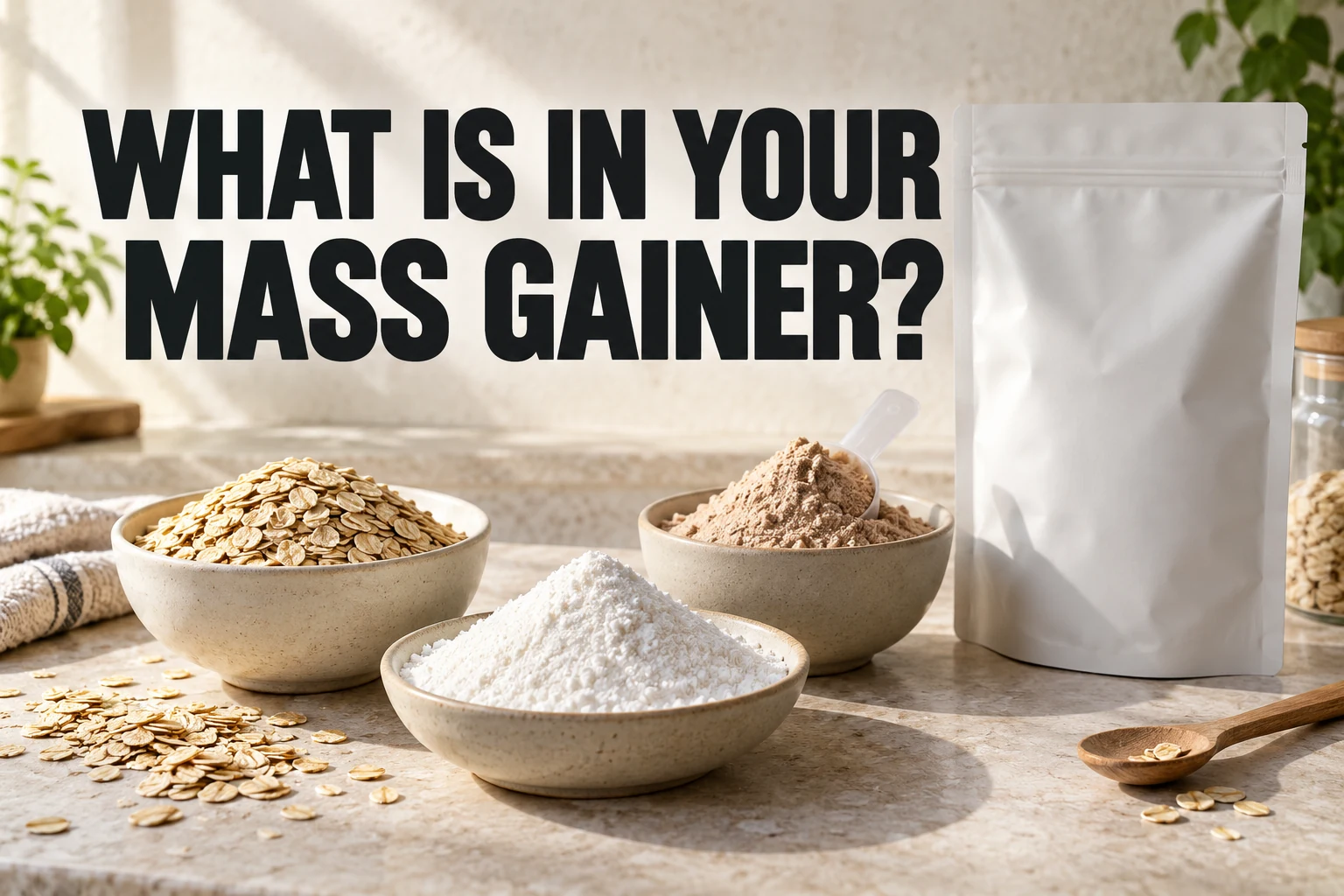
Here is the honest truth: most mass gainers are mostly maltodextrin. That is a cheap, highly processed carbohydrate derived from corn or wheat starch. It has a high glycemic index, no nutritional value beyond calories, and costs manufacturers very little to produce.
A typical mass gainer ingredient breakdown looks like this.
- 1
60 to 70% maltodextrin or a similar carb filler.
- 2
20 to 30% whey protein or a protein blend.
- 3
Flavouring, sweeteners, and thickeners.
- 4
Sometimes added creatine, glutamine, or vitamins.
The cheapest mass gainers in the UK right now
Some premium options swap maltodextrin for oat flour, sweet potato powder, or MCT oil. These are better nutritional choices, but they cost more.
Protein quality also varies hugely between brands. Some use 100% whey protein concentrate or isolate. Others pad the blend with cheap soy or wheat protein just to hit a number on the label without spending on quality ingredients.
For live, updated prices across every mass gainer we track, check the mass gainer comparison table. Prices change weekly, so always check before buying.
Community perspective
What others are saying
Is mass gainer more expensive than whey protein? Because where I live it's significantly cheaper. It's like half the price per unit of mass. Of course it comes with a shit ton of simple carbs and between 20-40 g of protein/100 g
u/Middle-Gas-6532 in r/workout
Mass gainers are just maltodextrin and low quality protein powders. So if the protein source is the issue, you could always just buy maltodextrin.
u/MythicalStrength in r/weightgain
Watch what buyers found
Hands-on opinions
Are Mass Gainers Worth It? Here’s What Science Really Says
FeastGood
A topic-specific video selected for additional practical context on Cheapest Mass Gainer UK Ingredients: What the Evidence Says.
Ingredients compared: what separates good from bad
Not all mass gainers are created equal. Here is what to look for on the label if you want a genuinely useful product.
| Rank | Product | Best for | ProteinDeals verdict |
|---|---|---|---|
| 1 | Whey protein concentrate or isolateFrom £49.95 Cons
| Best overall | listed as the first protein source. |
| 2 | Best-value alternative | as the main carbohydrate. | |
| 3 | Specialist option | , under 10g per 100g. |

Live comparison
Mass Gainer products
FlavourSize (g)QtyServingsOfferTotal Per 25g protein 5000148 £26.99 25.0g510£0.562 3000128.8 £23.99 25.0g510£0.833 2000119.2 £16.99 25.0g510£0.885 |
FlavourSize (g)QtyServingsOfferTotal Per 25g protein 5000149.6 £31.99 25.0g385£0.645 |
FlavourSize (g)QtyServingsOfferTotal Per 25g protein 4000138.4 £25.99£58.49 -56%25.0g399£0.677 |
FlavourSize (g)QtyServingsOfferTotal Per 25g protein 4000138.4 £25.99£58.49 -56%25.0g399£0.677 |
FlavourSize (g)QtyServingsOfferTotal Per 25g protein 5000144 £39.99£69.99 -43%25.0g426£0.909 |
FlavourSize (g)QtyServingsOfferTotal Per 25g protein 5000144 £39.99£69.99 -43%25.0g426£0.909 |
FlavourSize (g)QtyServingsOfferTotal Per 25g protein 5000137.8 £39.99£59.99 -33%25.0g500£1.058 |
FlavourSize (g)QtyServingsOfferTotal Per 25g protein 4000161 £33.99£42.99 -21%25.0g260£0.558 |
FlavourSize (g)QtyServingsOfferTotal Per 25g protein 8480164.4 £82.49 25.0g500£1.280 4240132.2 £46.99 25.0g500£1.458 2120116.1 £26.49 25.0g500£1.644 |
FlavourSize (g)QtyServingsOfferTotal Per 25g protein 2740119.7 £30.00 25.0g508£1.521 |
FlavourSize (g)QtyServingsOfferTotal Per 25g protein 5000156 £54.99 25.0g329£0.982 2500128 £29.99 25.0g329£1.071 1000111.2 £12.99 25.0g329£1.160 |
FlavourSize (g)QtyServingsOfferTotal Per 25g protein 2500131 £29.99 25.0g298£0.967 |
FlavourSize (g)QtyServingsOfferTotal Per 25g protein 4800133.6 £59.99 25.0g536£1.785 |
FlavourSize (g)QtyServingsOfferTotal Per 25g protein 5000156 £62.99£69.99 -10%25.0g329£1.125 1000111.2 £12.99£19.99 -35%25.0g329£1.160 2500128 £34.99£41.99 -17%25.0g329£1.250 |
FlavourSize (g)QtyServingsOfferTotal Per 25g protein 5000158 £63.99 25.0g326£1.103 2500133 £33.49 25.0g286£1.015 1000111.6 £14.99 25.0g326£1.292 |
FlavourSize (g)QtyServingsOfferTotal Per 25g protein 2500126 £32.99 25.0g352£1.269 |
FlavourSize (g)QtyServingsOfferTotal Per 25g protein 8000180 £107.49 25.0g385£1.344 4000140 £59.99 25.0g385£1.500 2000120 £34.99 25.0g385£1.750 |
FlavourSize (g)QtyServingsOfferTotal Per 25g protein 5000186 £68.99 25.0g215£0.802 2500143 £37.99 25.0g215£0.883 1000117.2 £16.99 25.0g215£0.988 |
FlavourSize (g)QtyServingsOfferTotal Per 25g protein 2721.55114.7 £38.00 25.0g666£2.582 997.915.5 £18.00 25.0g666£3.261 |
FlavourSize (g)QtyServingsOfferTotal Per 25g protein 5450132.7 £82.00 25.0g627£2.508 2730116.4 £50.00 25.0g627£3.053 |
FlavourSize (g)QtyServingsOfferTotal Per 25g protein 3200130.7 £49.95 25.0g394£1.626 |
FlavourSize (g)QtyServingsOfferTotal Per 25g protein 54001- £84.99 --- 20001- £39.99 --- |
FlavourSize (g)QtyServingsOfferTotal Per 25g protein 2267.96117.9 £39.00 25.0g491£2.177 |
FlavourSize (g)QtyServingsOfferTotal Per 25g protein 6000185.2 £107.99 25.0g270£1.267 3000142.6 £59.99 25.0g270£1.408 1500121.3 £35.99 25.0g270£1.690 |
FlavourSize (g)QtyServingsOfferTotal Per 25g protein 3150136 £69.95 25.0g333£1.943 |


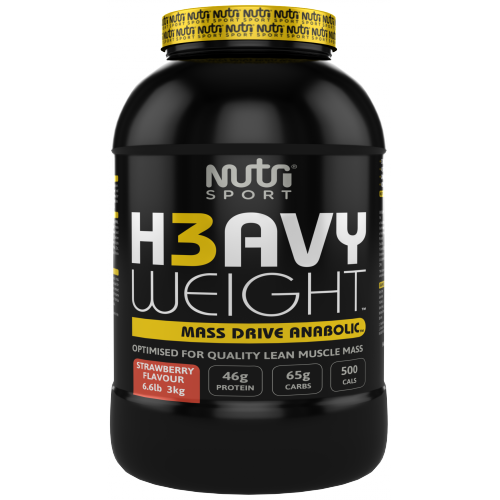


Best overall Mass Gainer
Pure Whey Mass
NXT Nutrition · 3.20kg
Cons
- 49% dearer per 25g protein than the median of 24 other Mass Gainer product families in this comparison
Warning signs of a weaker mass gainer
These are the signals that a product is leaning on filler rather than quality.
- 1
Maltodextrin listed first among the ingredients.
- 2
A protein blend that includes soy or wheat protein.
- 3
More than 10 ingredients on the label.
- 4
Sugar content above 15g per 100g.
Which brands get it right
MyProtein Impact Weight Gainer and Applied Nutrition Critical Mass use cleaner formulas than most. MyProtein leans on oat flour as its primary carb source, which gives slower energy release and more fibre than maltodextrin. Applied Nutrition includes added creatine, a genuinely useful extra.
Always compare products by protein per 100g rather than per serving. Serving sizes can run to 200g or even 300g or more, which makes per serving comparisons misleading. A product claiming "50g protein per serving" sounds impressive until you notice the serving itself is 334g.
Mass gainer vs making your own
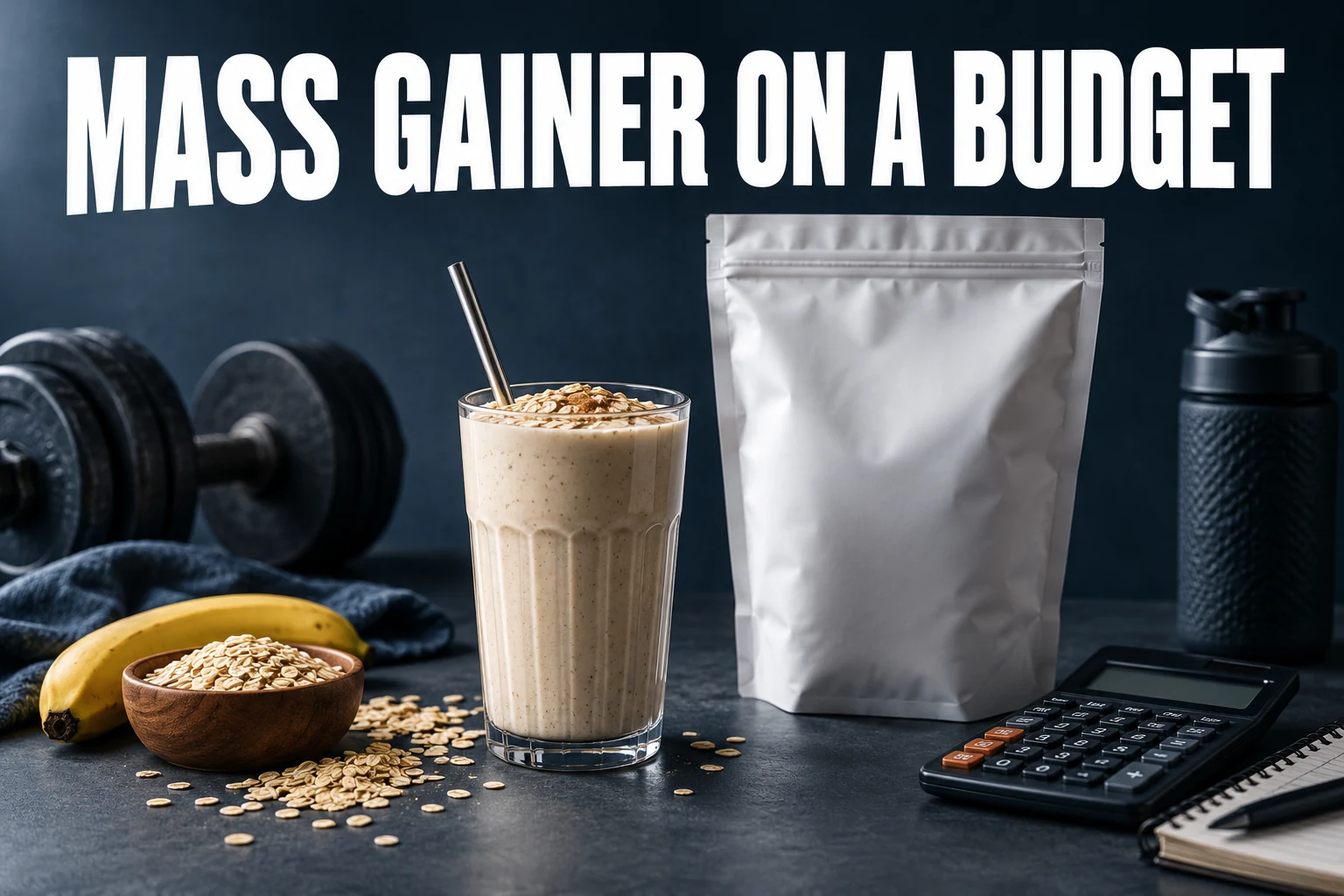
The cheapest mass gainer of all is the one you make yourself. A DIY mass gainer shake is simple to put together.
- 1
1 scoop whey protein (25g protein).
- 2
80g oats, blended into a powder.
- 3
1 tablespoon peanut butter.
- 4
1 banana.
- 5
300ml whole milk.
DIY versus buying a commercial tub
That combination gives you roughly 700 calories and 45g of protein. The cost works out to around £1 to £1.50 per shake using supermarket ingredients and a decent whey concentrate.
A commercial mass gainer typically costs £2 to £4 per shake, depending on the brand and bag size, so a DIY shake saves roughly 50 to 70% per serving.
The trade off is convenience. Commercial mass gainers are faster to prepare, since it is scoop, shake, done, while a DIY shake needs a blender and a few minutes of prep. If you are rushing between lectures or shifts, that matters more than the saving.
For a deeper dive into the cost breakdown, read our affordable mass gainer UK guide.
Mass gainer vs whey protein: which should you buy?
This is the question most people should ask before buying a mass gainer at all. In most cases, whey protein is the better buy.
Whey protein gives you more protein per pound spent. A typical whey concentrate delivers 70 to 80g of protein per 100g, while a typical mass gainer delivers only 20 to 30g. Per 25g protein, whey is dramatically cheaper.
If you can eat enough food to hit your calorie target, buy whey protein and eat more food instead. It is cheaper, cleaner, and gives you more flexibility with your diet.
Mass gainers really only make sense in one scenario: your appetite is genuinely too low to eat enough solid food. If you are already eating three meals a day and still not gaining weight, a mass gainer shake between meals can help bridge that gap.
For most people though, a bag of whey concentrate with your own added carbs is the smarter move.
The verdict
Most mass gainers are overpriced maltodextrin. That is the blunt reality, and you are paying a premium for convenience and marketing rather than quality nutrition.
A few options do stand out. MyProtein Impact Weight Gainer uses oat based carbs and delivers 29g protein per 100g. Applied Nutrition Critical Mass offers 28g protein per 100g with added creatine. These are the ones worth considering if you genuinely need a commercial mass gainer.
For the latest prices on every mass gainer we track, check the mass gainer comparison table. It updates weekly and sorts by best value per serving.
References
Sources and further reading
- 01Competition and Markets Authority — price-reduction claims
UK guidance relevant to reference prices, discount claims and online urgency messaging.