

Quick answer
Start around 100–200mg and count every caffeine source that day. EFSA's general healthy-adult guidance is not a performance target and does not make 300–400mg the right dose for you. Body size, pregnancy, medication, anxiety, heart symptoms, sleep and individual sensitivity all change the decision. Our preference is the lowest dose that improves training without harming sleep. Avoid dry scooping, do not stack pre-workout with energy drinks, and choose stimulant-free training products for late sessions.
The EFSA limits, in plain numbers
Three numbers matter most for anyone taking a pre-workout.
- 1
200 milligrams per single dose. The safe single serving for healthy adults, including during or immediately before exercise. Most Applied Nutrition ABE servings and Grenade .50 Calibre servings sit right at this 200 milligram limit.
- 2
400 milligrams per day total. The combined upper limit across coffee, tea, energy drinks, chocolate and pre-workout. Regularly going above this is linked to anxiety, palpitations and sleep disruption in healthy adults.
- 3
600 milligrams per day as the hard ceiling. Beyond 600 milligrams daily, EFSA flags meaningful risk of adverse cardiovascular and central nervous system effects. This is the point where caffeine stops being a useful training tool and starts becoming a health concern.
How much caffeine is already in your day before the pre-workout
A typical UK day carries more caffeine than most people realise once you actually add it up:
- 1
A medium filter coffee contains 95 to 165 milligrams of caffeine.
- 2
A 250ml cup of black tea contains 40 to 70 milligrams.
- 3
A 330ml can of Coca-Cola contains 32 milligrams.
- 4
A 250ml can of Red Bull contains 80 milligrams.
- 5
A 500ml can of Monster Energy contains 160 milligrams.
- 6
A 100 gram bar of dark chocolate contains 43 milligrams.
Where the daily limit gets exceeded
Two coffees, around 250 milligrams combined, plus a 200 milligram pre-workout already reaches 450 milligrams, above the daily safe limit. This is the single most common way lifters end up over the EFSA threshold without ever realising it.
Community perspective
What others are saying
Watch what buyers found
Hands-on opinions
PRE-WORKOUT EXPLAINED! — What Is It & Should You Be Using Pre-Workout Supplements? | Doctor ER
Doctor ER
A topic-specific video selected for additional practical context on Caffeine in Pre Workout How Much is Safe: Benefits, Risks and Label Checks.
Side effects at different dose tiers
Side effects scale fairly predictably with dose and individual sensitivity. Research and EFSA guidance map out three tiers.
- 1
Under 200 milligrams per single dose. Most users experience improved alertness and perceived energy with no negative effects. Slow metabolisers may still see sleep disruption if it's taken within 6 hours of bedtime.
- 2
200 to 400 milligrams per single dose. Noticeable jitters, elevated resting heart rate and increased sweating start to appear. Some users report anxiety or difficulty focusing, which is the opposite of the intended effect. Still within safe limits for healthy adults taken occasionally.
- 3
Over 400 milligrams per single dose. Outside EFSA safe guidance. Symptoms include palpitations, tremor, nausea and sleep disruption lasting 8 to 12 hours. Prolonged exposure at this level is linked to elevated blood pressure.

Cheapest Pre-Workout
Impact Pre-Workout
MyProtein · 500g
Genetic variation: fast vs slow metabolisers
Caffeine is metabolised primarily by the CYP1A2 enzyme in the liver, and the gene encoding CYP1A2 has two common variants that determine how quickly that happens. Fast metabolisers (AA genotype) clear caffeine with a half-life of roughly 4 to 5 hours. Slow metabolisers (AC or CC genotypes) have a half-life of 7 to 10 hours instead. Roughly 50 to 60 percent of Europeans are fast metabolisers.
The practical effect matters more here than the underlying biology. A 200 milligram dose taken at 8am has dropped to around 50 milligrams by 4pm for a fast metaboliser. For a slow metaboliser it's still sitting around 100 milligrams at 4pm, enough to disrupt sleep come 10pm. Slow metabolisers should cap pre-workout caffeine at 100 milligrams, take it earlier in the day, or choose a stim-free pre-workout entirely.
You can identify your own type without needing a genetic test. If coffee after noon noticeably affects your sleep, you're likely a slow metaboliser. If you can drink an espresso at 6pm and still fall asleep at 11pm without trouble, you're likely a fast metaboliser.
Who should avoid high-caffeine pre-workouts
High-caffeine pre-workouts, meaning 300 milligrams or more per serving, are not appropriate for everyone.
- 1
Anyone with diagnosed heart arrhythmia, elevated blood pressure, or an anxiety disorder.
- 2
Pregnant or breastfeeding women. EFSA lowers the daily safe limit to 200 milligrams total for this group.
- 3
Anyone under 18. There is no EFSA-established safe dose for adolescents.
- 4
Slow caffeine metabolisers training in the afternoon or evening.
- 5
Anyone on medications that interact with caffeine, including some antidepressants, cardiac medications, and antibiotics.
UK pre-workouts across the caffeine spectrum
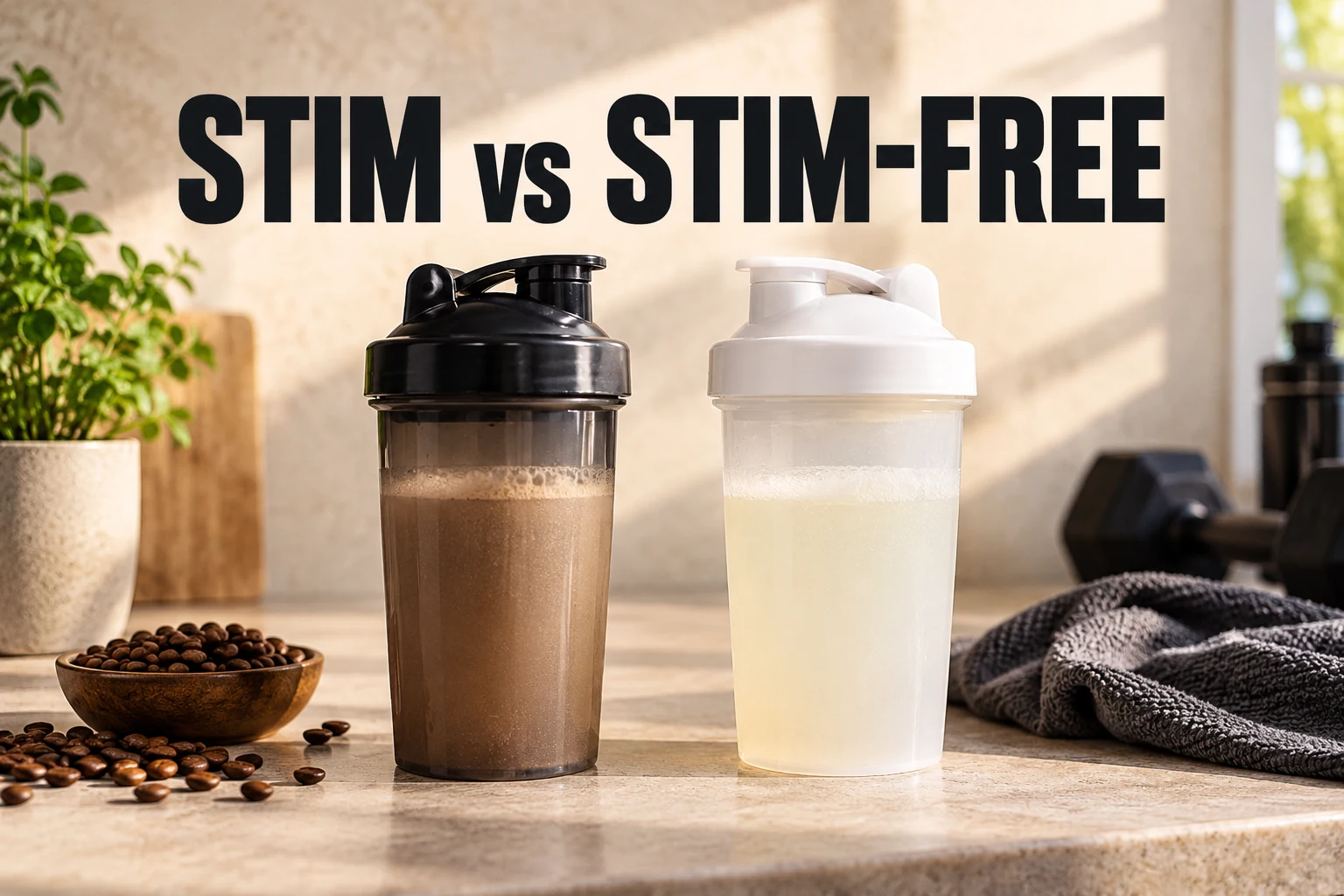
Three UK products span the stim range from zero caffeine to moderate. For the stim versus stim-free decision, see Stim vs Stim-Free Pre-Workout. For the full UK pre-workout comparison, see the pre-workout comparison table.
References
Sources and further reading
- 01EFSA — scientific opinion on caffeine safety
European assessment used for general healthy-adult single-dose and daily caffeine guidance.